01
Record
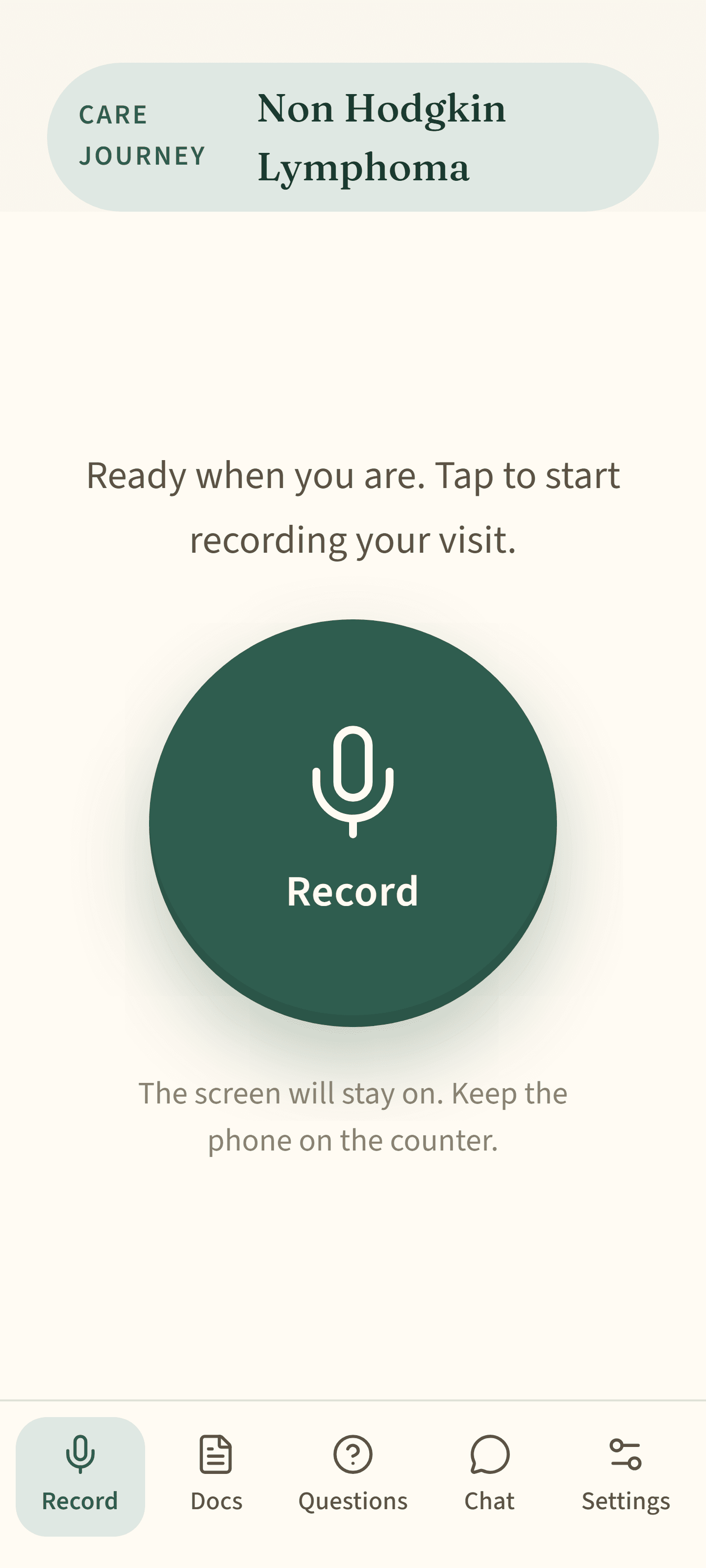
Tap record. Our medical-grade transcription captures every word.
Ground to stand on when nothing else is solid.
Get early accessHow PatientSide works
Tap record. Our medical-grade transcription captures every word.
Our AI creates personalized summaries of every visit and care guides so you always know what happened, what’s coming, where the gaps are, and what to do.
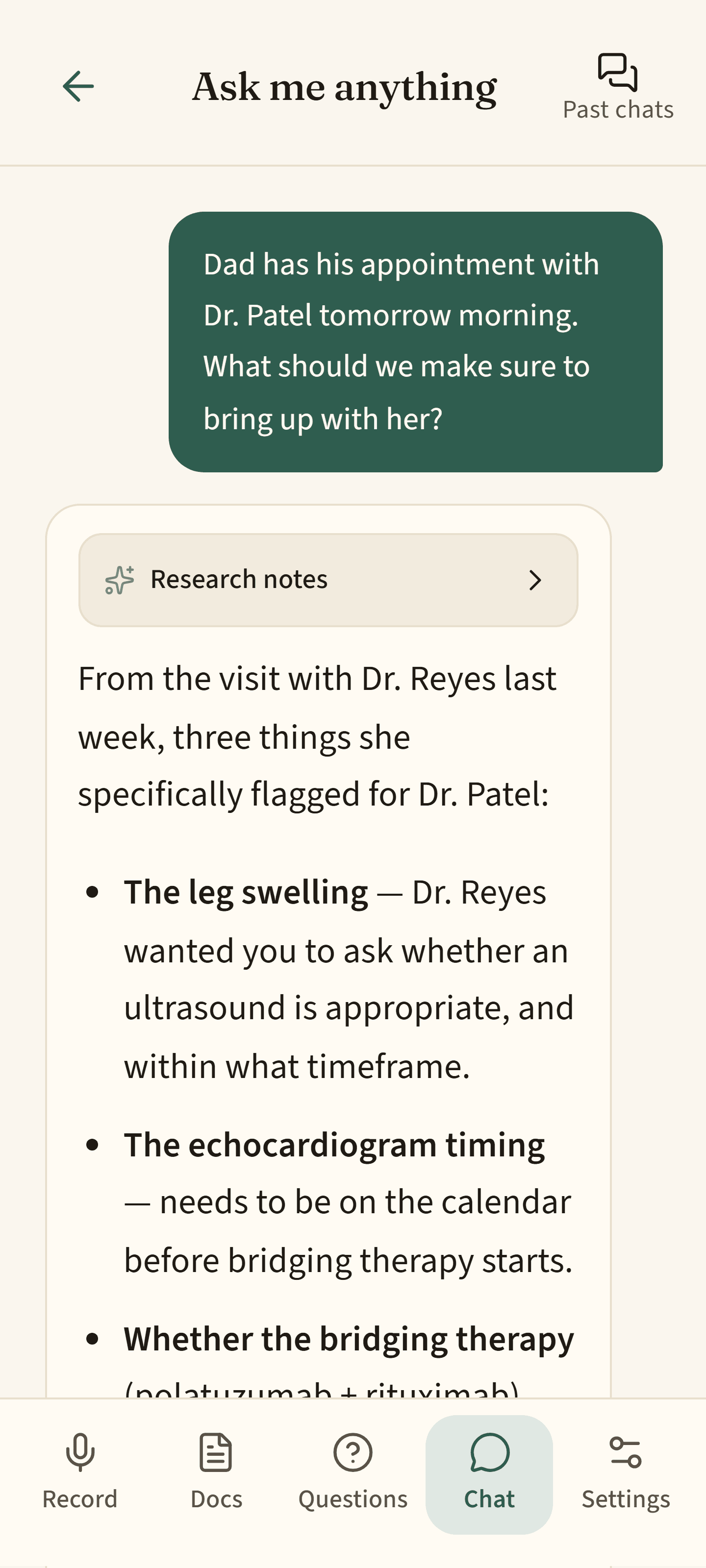
Ask our patient advocate AI questions, review past consults, and walk into every visit prepared.
What you get
Our AI is trained on patient advocacy and uses your records, consults, and up-to-date research to tell you and your family —
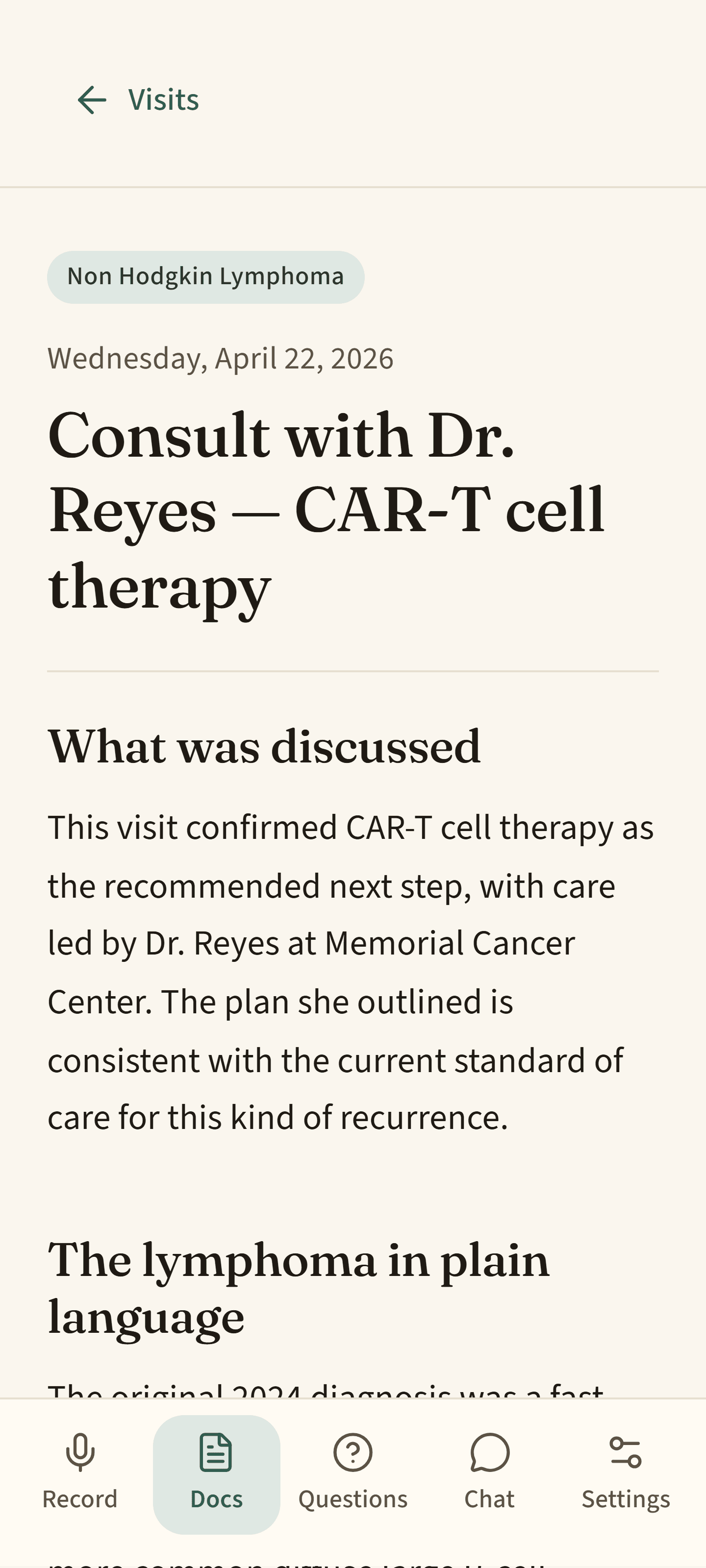
Every consult, in writing — the reasoning, the alternatives, the things mentioned in passing.
Wednesday, April 22, 2026
What was discussed
This visit confirmed CAR-T cell therapy as the recommended next step, with care led by Dr. Reyes at Memorial Cancer Center. The plan she outlined is consistent with the current standard of care for this kind of recurrence.
The lymphoma in plain language
The original 2024 diagnosis was a fast-growing form of non-Hodgkin lymphoma. The recurrence Dr. Reyes spoke about today is in the same family — meaning the treatment options are the ones already on her shelf, including CAR-T, which she described as
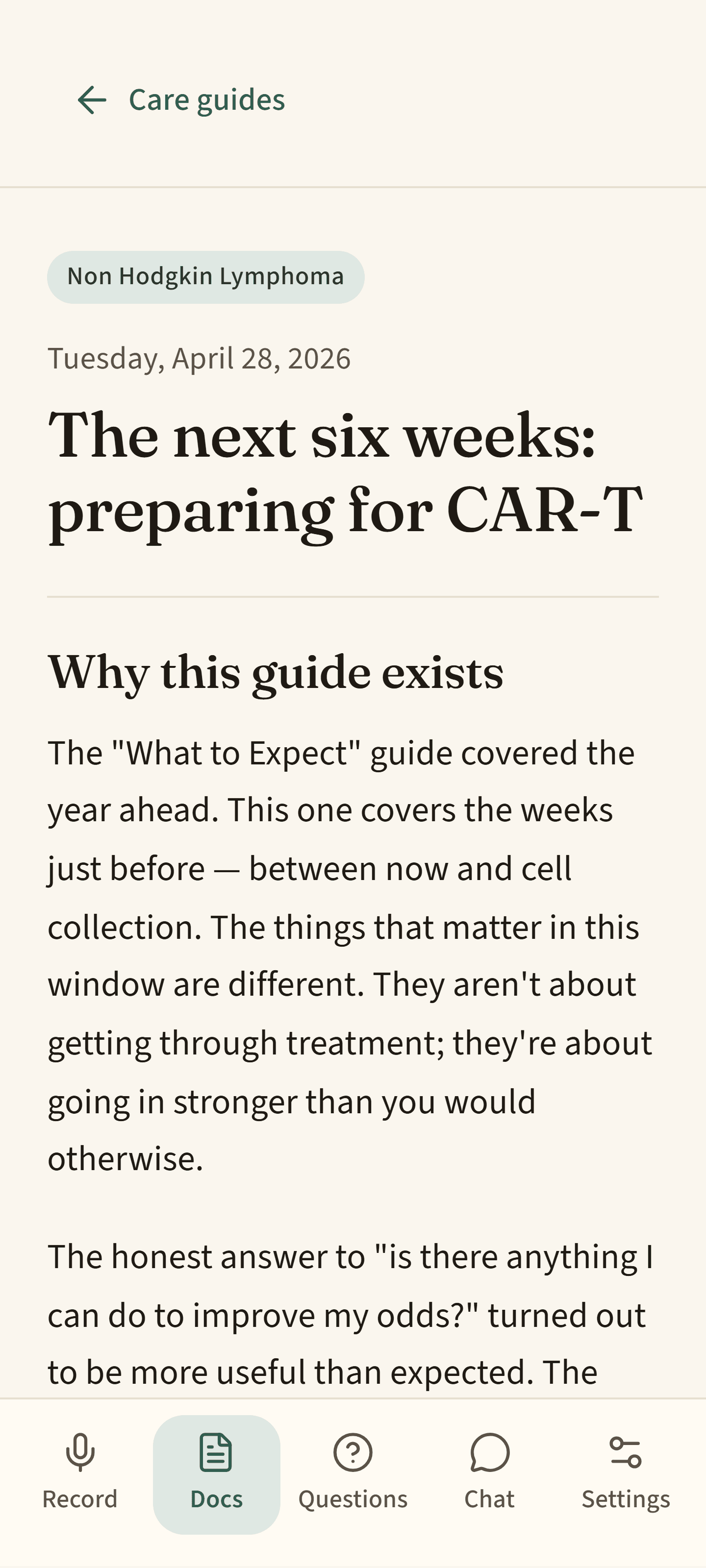
A map of your treatment, phase by phase — what hits when, what to plan around.
Phase 2 of 4
Between now and cell collection, the goal is straightforward: keep your body strong, hold the medication schedule steady, and watch for the few things that matter.
What hits when
Questions you didn’t think to ask. Follow-ups that got mentioned in passing. Surfaced for you, by provider.
For your follow-up this Friday
If the pre-treatment scan looks the same as last month, does the May timeline still hold?
You mentioned bridging therapy as a possibility — what would make that the right call?
For Sandra Liu, RN — care coordinator
What should we be watching for at home between now and cell collection?
Lodging within walking distance of the hospital — is there a list you
Specific evidence-backed actions calibrated to your treatment — the strongest levers, with research behind them and named programs at your cancer center.
For patients heading into CAR-T, sarcopenia (low muscle mass at the start of therapy) is one of the most consistent predictors of harder recoveries. The good news: it’s one of the few things you can move on directly in the weeks before treatment.
Two concrete actions
Sources: Williams et al. JCO 2023; Memorial Cancer Center PrehabPlus referral form (linked in your care guide).
Now accepting signups for the early access waitlist.
Why this exists
When my Dad’s cancer returned the family was in shock and unsure what to do. Our first consult at Dana Farber was helpful, but difficult to process. We were struggling to come to terms with the situation much less comprehend or plan for the future.
I built PatientSide so that my dad and my family could do just that. Visit summaries helped us to understand what was being said and what to expect. Care guides helped my Mom and the rest of the family know what to do and give my Dad the best chance of beating cancer.
PatientSide has brought our family onto the same page, helped us know what to expect, what to ask, and how to prepare. More importantly, it removed the fog, uncertainty, and shakiness and gave everyone ground to stand on and a way to help. It’s my hope that what PatientSide has done for us it can do for other families.
— Braden, founder.
Ready to join the early access list? → Thank you for your interest! We’ll be in touch shortly about access